
Skip to content

Our Members

For the year ended 20 February 2026

168 M+
Owned tonnage declared to IGP&I in April 2026
110 M+
Chartered tonnage
6,952
Total ship count
4453
Ship count (above 1,500 GT)
10 %
Americas
44 %
Europe, Middle East & Africa
46 %
Pacific Asia

Chairman's Statement

The TT Club insures around 80% of the world’s containers and has an insurable interest in 55% of the world’s top 100 ports. The club was established in 1968 to provide mutual liability cover for the onshore legs of container transport, later diversifying into insuring logistics operators and ports and terminals. TT Club has more than 1,500 members, a global network of 26 offices and reserves of over US$300 million. Most of our staff around the world are already operating alongside each other, so we already know each other well and have collaborated on a wide range of projects.

The potential benefits and efficiencies resulting from the merger – which is likely to include the acquisition of our Manager, Thomas Miller – will be significant, resulting in a projected saving equivalent to 5% of P&I premiums. It will also give Members more local access to the Club, a wider spread of cost-effective transport insurance products, and a larger and more financially secure capital base. By February 2027, we will have taken a significant step towards our goal of being the world’s leading maritime transport mutual – watch this space.

In the meantime, the Club has experienced a less expensive policy year than the record set in 2024, though our contributions to International Group Pool claims continue to be significant. Containership incidents – such as the MSC Elsa 3 sinking in May 2025 and the Wan Hai 503 fire in June 2025, both off the coast of India – continue to cause concern and we are working closely with the industry to consider further loss prevention enhancements. The Group Pooling Agreement is a key strength of the P&I system, enabling us and the other International Group Clubs to collectively and efficiently manage the cost of the largest claims. The slight easing of Pool contributions and fewer large claims in our US$10 million retention resulted in a more acceptable combined ratio of 105%, compared to 116% last year. This relatively small underwriting deficit was more than offset by a strong 9.4% investment return, which helped to boost our free reserves from US$494 million to US$586 million. I am also pleased to say our focused UK Fixed, Charterers and other non-mutual products contributed to our surplus this year.

Thanks to a significant increase in free reserves, the UK Club again remains one of the strongest Clubs in the International Group. We continue to surpass all regulatory requirements and industry benchmarks, including holding a Solvency-UK Capital Adequacy Ratio (SCR) of 244% and exceeding the S&P capital model’s 99.99% confidence level.

The UK Club’s combined offering of financial strength and exceptional service resulted in another positive renewal in February 2026. Nearly all existing Members renewed for another 12 months, with many expanding their entries with the Club. Over the year, our mutual tonnage grew by over 6 million GT to 168 million GT. We have experienced particularly strong growth from high-quality operators of tankers and containerships, which has helped to diversify our insured fleet, and existing Members have already committed to entering a significant amount of new tonnage during the 2026 policy year. Chartered entries have stayed strong at around 110 million GT.

Looking ahead, we will continue to focus on developing long-term partnerships with our Members through service excellence. We are also planning another Member and broker survey this year to ensure we have delivered measurable improvements in the areas identified in the May 2024 survey – even though this found overall satisfaction with the Club’s service was 99%. Improvements include creating dedicated centres of excellence to provide focused insight, sector leadership and consistently high-quality guidance on major trades and topical issues such as alternative fuels and sanctions.

As ever, I am grateful to all Members who have served so diligently as Directors on the Club’s regulated Board and Members’ Committee. During the year, we welcomed Tomás Arantes (Transpetro); Howard Flanders (Norwegian Cruise Line) and Nick Potter (AET) to the Members’ Committee, which continues to provide a vital link between the Board and our Members. We also thank K. Fujiwara (ENEOS Ocean); I. Gungen (Gungen Maritime & Trading); P. Hajioannou (Safe Bulkers); E. Louis-Dreyfus (Louis-Dreyfus Armateurs); F. Mascarenhas (Transpetro); and R. Zein (Naftomar Shipping & Trading), who have stepped down after many years of outstanding service.

Finally, I again want to thank our staff. Their professionalism and dedication in often challenging circumstances continues to provide Members, brokers and other stakeholders with the highest-level service they rightly expect from such a prestige Club. It is through their collective efforts that the UK Club keeps getting bigger, better and bolder.

J.M. Valkier Chair

20 May 2026

Our Board

The Directors have pleasure in presenting their Report and Financial Statements of the UK P&I Club for the year ended 20 February 2026.

The Club has been protecting our Members from third-party liabilities and related claims-handling expenses in the form of protection and indemnity (P&I) insurance and other marine covers for over 150 years. Control over the Club’s affairs rests with the Board of Directors, which met on five occasions during the year. The members of the Board are elected by the Members’ Committee, the membership of which is in turn elected by the Members of the Club.

Structure 

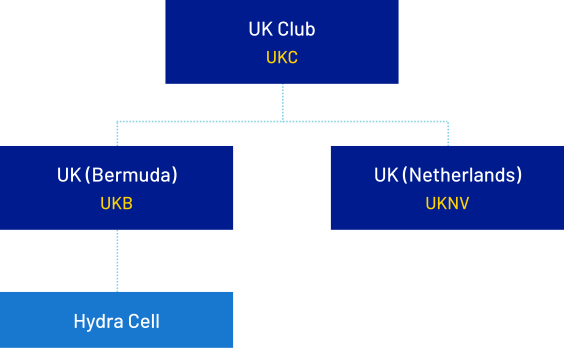
The principal activity of the Club during the year was the insurance and reinsurance of the marine protection and indemnity risks on behalf of our Members. The Club has the following active corporate structure

Meet our Members’ Committee

Meet our Board of Directors

Underwriting Performance

The Club aims to maintain breakeven underwriting over the medium term by calling sufficient premium to cover claims and expenses incurred.

Over recent years, pricing has recovered following the previous soft market cycle and, for the 2026 renewal, this momentum has continued.

The mutual premium increase achieved at the recent renewal is in line with the Club’s longer-term financial forecast and the Club continues to refine its risk appetite and take appropriate action to improve the overall portfolio composition of mutual and fixed premium business entered.

The combined ratio of 105% is at the top of the Club’s target combined ratio range.

The Club’s non-poolable business has contributed positively to the Club’s financial performance, continuing the trend set last year following several years of portfolio remediation.

The Club is reporting year-on-year growth of 6.9 million GT of mutual entered tonnage, equivalent to a 4.3% gain, whilst continuing to remove underperforming business. The Club also continues to enjoy a strong pipeline of new tonnage committed by existing Members to attach during the forthcoming policy year.

The Club continues to purchase appropriate reinsurance to protect against portfolio volatility and manage capital efficiency.

Combined Ratio

Claims Position

Volatility continues to be the underlying theme of P&I claims in the 21st century. The 2025 policy year saw the UK Club on the right side of that volatility, with a significantly better than anticipated experience in its retained and non-mutual claims.   

All categories of claims saw a fall in value, with cargo and injury claims reported at around 30% of the previous year’s figures. Large claims, those above US$500,000, were less than 50% of the 2024 policy year, and the lowest in over 10 years. Most encouragingly, the level of attritional claims – those below US$500,000 – fell by over 10% against tonnage growth of almost the same percentage.

With one exception, no particular trends or emerging claims risks were noticeable to distinguish the 2025 policy year from previous years. The exception was an increase in claims for contamination to chemical cargoes, in many cases caused by failings in tank cleaning between cargoes. These often initially present as large claims, although salvage sales and treatment of the cargoes in question often mitigate the losses. Nevertheless, this is an issue that has the attention of the Club’s Safety & Risk Management division. The large claims experienced were a mixture of routine dock damage cases, collisions and, regrettably, avoidable illnesses and injuries. 

The Director’s Report for 2025 noted two major containership fires and commented on the challenges that these incidents pose in terms of ports of refuge and disposing of fire-damaged waste. One of these incidents involving a relatively small containership continued to develop during the 2025 financial year and resulted in costs of over US$100 million, albeit with strong prospects of a recovery from the ship’s charterers. Almost as soon as that incident was resolved, there was another major fire on a containership, this time entered in another IG Club, which ship found refuge in the same port as the UK Club’s case and incurred a proportionately similar level of costs.     

All of the cases are thought to have resulted from the carriage of undeclared dangerous goods, which is also likely to be the cause of a large claim against a charterer Member of the Club. It is perhaps therefore appropriate that the IG Clubs have made it a requirement in 2026 that their respective Members preserve rights of recourse for the carriage of undeclared dangerous goods in contracts for carriage, reflecting long-established principles under international conventions and national laws that a carrier should be compensated for losses where notice that the goods are dangerous has not been given. With that in mind, the February 2025 decision of the United Kingdom Supreme Court in the MSC FLAMINIA case expanding the scope of claims for which a charterer can limit liability was a disappointing one for shipowners. It has been argued that the case levels the playing field in terms of a charterer’s right to the full benefit of limitation. However, it also risks an innocent shipowner being left with unrecoverable losses in such cases and could enable the guilty shippers to evade the consequences of their actions 

The Club’s fixed premium book has performed well. Two large claims in particular have been mitigated by limitation, through the relatively small size of the ships involved. Encouragingly, against occasional concerns at the willingness of some courts to uphold the concept, three of the Club’s older claims were also successfully resolved through limitation, with claims presented often significantly in excess of the ships’ limitation fund. Some might question the role of limitations in the modern world. However, for the Club and the IGP&I generally, it remains a cornerstone of predictable and insurable risk enabling cost effective insurance. 

Total Net Notified Claims by Size and Frequency at 12 Months’ Development

Investments

During the 2025/26 financial year, the consolidated investment portfolio delivered a total return of 9.4%. The portfolio enjoyed strong performance despite a backdrop of elevated economic and geopolitical uncertainty. All segments of the portfolio contributed positively to the results, led by the equity allocation, which produced a return of 24.1%. Fixed income exposures also contributed positively, with corporate and government bond holdings producing a combined return of 6.2%.

Despite extended periods of volatility, global equity markets demonstrated resilience throughout the year, reaching new record levels. Nevertheless, the Club has taken a cautious approach to the management of the portfolio to mitigate ongoing risk emanating from geopolitical uncertainty and stretched market valuations.

The investment strategy is designed to ensure that the portfolio continues to support the Club’s financial objectives. Overall, the asset allocation of the club’s investment portfolio remains consistent with its risk appetite, capital and regulatory constraints, expected liabilities and credit rating requirements.

Investment return

Investment Allocation (as at 20 Feb 2026)

  • 56% Government Bonds
  • 21% Equity & Alternatives
  • 15% Cash
  • 8% Corporate Bonds

The Club’s capital continues to exceed the ‘99.99%’ confidence level as per S&P’s capital model.

J.M. Valkier - Chair

Capital

The Club has a strong capital position, with free reserves of US$586 million. The Club aims to hold sufficient capital to provide our Members with first-class security without holding excessive amounts. As such, the Club’s key objectives are to maintain its rating from S&P within the ‘A’ range and retain sufficient capital to meet its regulatory requirements in all jurisdictions. The Club’s capital continues to exceed the 99.99% confidence level as per S&P’s capital model. The Club’s credit rating of ‘A-/Stable’ was most recently confirmed by S&P in November 2025.

The Club’s key regulatory capital requirement is Solvency-UK’s Solvency Capital Requirement (SCR). Rather than use the standard formula to calculate the Club’s SCR, the Club uses its own sophisticated internal model, which better reflects the Club’s risks and avoids it having to hold unnecessary levels of Members’ capital.

The Club’s regulatory capital coverage is shown in the following chart, which illustrates its SCR, broken down into key risk categories. For further information, see the Club’s Solvency and Financial Condition Report, which is available on the Club’s website.

Group regulatory capital - 2026

Keep informed. We produce a wide range of publications, circulars and newsletters.

Subscribe