

進化し続ける海事業界において、規制変更を早めに把握し、コンプライアンスを確保しつつ効率的な運航を続けることが不可欠です。当クラブは昨年、2025年に発効されるIMOの主要な規制をまとめた記事を掲載しました。本稿では、安全性および環境保護を強化するため、2026年に発効予定のIMO規制の概要を説明しています。
Introduction
As the maritime industry continues to evolve, it is imperative that our Members stay ahead of the regulatory changes to ensure compliance and operational efficiency.
The Club previously published an article summarising key IMO regulations that came into effect in 2025. This article presents an overview of the upcoming regulations in 2026 to improve safety and environmental protection.
Regulations coming into force on 1 January 2026
Amendments to the IMDG Code (42-24) – MSC.556(108)
The 2024 Edition of the International Maritime Dangerous Goods (IMDG) Code, which has been applicable on a voluntary basis since 1 January 2025, entered into force on 1 January 2026.
Several significant revisions have been introduced in this edition. Some of the key changes include stringent packaging and testing requirements for lithium batteries, stricter regulations for charcoal/carbon cargoes (UN1361/1362) and new UN numbers.
The NCB Hazcheck has issued a detailed summary of the changes, which is recommended reading.
Members involved in the transport of dangerous goods in packaged form are recommended to ensure compliance with the latest 2024 Edition of the IMDG Code.
Amendments to the IMSBC Code (08-25) – MSC.575(110)
The latest amendments to the International Maritime Solid Bulk Cargoes (IMSBC) Code will enter into force on 1 January 2027. However, importantly, some contracting governments may apply these amendments (or parts thereof) on a voluntary basis from 1 January 2026.
- The following amendments have been made to Appendix 1 (individual schedule of solid bulk cargoes):
- Amended cargo entries
Bulk Cargo Shipping Name (BCSN) | Summary of changes |
ALUMINIUM FERROSILICON POWDER UN 1395 | Delete the last sentence under “Precautions”. |
ALUMINIUM SILICON POWDER, UNCOATED UN 1398 | Delete the last sentence under “Precautions”. |
ALUMINIUM SMELTING BY-PRODUCTS or ALUMINIUM REMELTING BY-PRODUCTS UN 3170 | Delete the second-last sentence under “Precautions”. |
CASTOR BEANS or CASTOR MEAL or CASTOR POMACE or CASTOR FLAKE UN 2969 |
|
DIRECT REDUCED IRON (A), Briquettes, hot-moulded |
Loading – Third Paragraph
|
DIRECT REDUCED IRON (B), Lumps, pellets, cold-moulded briquettes |
|
FERROSILICON UN 1408 with 30% or more but less than 90% silicon (including briquettes) | Delete the first paragraph of the “General requirements for carriage” section. |
FERROSILICON with at least 25% but less than 30% silicon, or 90% or more silicon | Paragraph 1 replaced:
|
FERROUS METAL BORINGS, SHAVINGS, TURNINGS or CUTTINGS UN 2793 in a form liable to self-heating | Under “Carriage”, delete the alternative requirement for additional SCBA sets. |
FISH MEAL (FISH SCRAP), STABILISED Anti-oxidant treated |
|
IRON ORE PELLETS |
|
- New cargo entries
Bulk Cargo Shipping Name (BCSN) | Group | Hazard |
ALUMINIUM SULPHATE GRANULAR | B | MHB (CR) |
APATITE CONCENTRATE | A |
|
ASPHALT GRANULATES | C |
|
CRUSHED GRANODIORITE, COARSE | C |
|
FERRIC SULPHATE GRANULAR | B | MHB (CR) |
FISH MEAL (FISH SCRAP), STABILISD | C |
|
IRON ORE BRIQUETTES | C |
|
PEA PROTEIN CONCENTRATE PELLETS | C |
|
PHOSPHATE ROCK FINES (uncalcined) | A |
|
TUFF, COARSE | C |
|
ZINC SLAG (coarse) | C |
|
- The list of non-cohesive cargoes (Appendix 3 of the IMSBC Code) has been amended to include the following cargoes:
- ALUMINIUM SULPHATE GRANULAR
- ASPHALT GRANULATES
- CRUSHED GRANODIORITE, COARSE
- FERRIC SULPHATE GRANULAR
- PEA PROTEIN CONCENTRATE PELLETS
- PHOSPHATE ROCK FINES (uncalcined)
- Section 3 on the “Safety of Personnel and Ship”, has been updated to include guidance on cargo under in-transit fumigation, referencing the revised IMO recommendations for the safe use of pesticides (MSC.1/Circ.1264/Rev.1). Footnotes and references have been updated for clarity and alignment with the latest safety practices.
- The segregation table in section 9 “Materials Possessing Chemical Hazards” has been amended for bulk materials classified as dangerous goods. Changes include updated terminology, clearer separation requirements for radioactive materials and removal of outdated references to “MHB”. The table now better reflects current best practices for stowage and segregation of hazardous bulk cargoes.
- Section 13 on the “References to Related Information and Recommendations” has been updated to the latest IMO circulars.
- The list of Solid Bulk Cargoes for which a Fixed Gas Fire Extinguishing System may be exempted has been updated to its 7th revision to include the cargoes “ALUMINIUM SULPHATE GRANULAR”, “CASTOR BEANS UN 2969” and “FERRIC SULPHATE GRANULAR”, which can be exempted from having a fixed CO2 fire-fighting installation on board ships (MSC.1/Circ.1395/Rev.7).
Members involved in the transportation of solid bulk cargoes are recommended to review these changes in detail, update shipboard procedures and ensure crew training reflects the latest safety, stowage and emergency protocols. Compliance is mandatory from 1 January 2027, but early adoption is encouraged.
Amendments to the International Grain Code – MSC.552(108)
SOLAS Chapter VI, Part C requires bulk carriers carrying grain on international voyages to comply with the Grain Code and maintain an approved grain loading manual.
The Grain Code currently contains three loading conditions:
- Filled compartments, trimmed – the bulk grain shall be trimmed to fill all spaces under the decks and hatch covers to the maximum extent possible.
- Filled compartments, untrimmed – the bulk grain shall be filled to the maximum extent possible in way of the hatch opening but may be at its natural angle of repose outside the periphery of the hatch opening.
- Partly filled compartments – refers to any cargo space wherein the bulk grain is not loaded in the manner prescribed for the other two conditions.
This amendment adds a fourth optional loading condition:
- Especially suitable compartment, partly filled in way of the hatch opening, with ends untrimmed (see figure below):
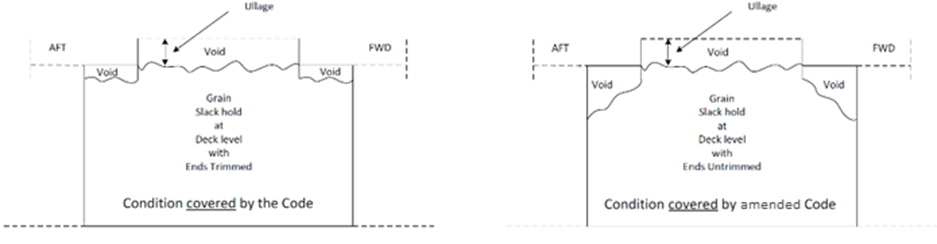
This provision offers increased flexibility where full trimming was previously required. The amended condition is optional. However, if Members wish to carry grain in this newly outlined condition, then they need to approach their Flag State/Class and ensure this condition is included in its approved grain loading manual and the loading computer.
New SOLAS Regulation II-1/3-13 – Lifting Appliances and Anchor Handling Winches – MSC.532(107)
Previously, ship’s cranes were regulated under ILO 152, not by the IMO. However, these IMO requirements now mandate the design, construction, operation, testing and maintenance requirements for lifting appliances and anchor handling winches.
These requirements also apply to lifting appliances with a safe working load (SWL) below 1 tonne, unless the Flag State grants specific exemptions. However, certain lifting appliances, including those used on offshore construction ships and LSA launching appliances, are outside the scope of this regulation.
Essentially, all new lifting appliances, including loose gear, installed on or after 1 January 2026, will be required to comply with the following:
- The design, construction and installation shall be in accordance with the Class requirements recognised by the Flag State.
- Load test and thorough examination shall be carried out after installation and before being taken into use for the first time, and after repairs, modifications or alterations of a major character.
- These appliances shall be permanently marked and provided with documentary evidence for the SWL.
For existing lifting appliances and loose gear, installed before 1 January 2026, the following requirements will apply:
- Undergo load test and thorough examination by first safety construction renewal survey on or after 1 January 2026.
- These appliances shall be permanently marked and include documentary evidence of the SWL. Existing certificates issued under other international instruments, such as ILO 152, will be acceptable for compliance.
- In instances where the SWL of the lifting appliances is undocumented and design information is not available, and the manufacturer no longer exists, the test load shall be calculated using table 1 of MSC.1/Circ.1663, based on a SWL nominated by the company, to the satisfaction of the vessel’s Class.
Similarly, for anchor handling winches installed on or after 1 January 2026, the design, construction and installation shall be in accordance with the Class requirements recognised by the Flag State. Whereas, anchor handling winches installed before 1 January 2026 shall be tested and thoroughly examined, based on MSC.1/Circ.1662, by first safety construction renewal survey on or after 1 January 2026.
Members are recommended to refer to MSC.1/Circ.1696 and ensure that lifting appliances and anchor handling winches are part of the onboard maintenance programme.
All certified lifting appliances and loose gear should be recorded in the Register of Ship’s Lifting Appliances and Cargo Handling Gear, with the certificate of test and thorough examination attached. The loose gear deemed unsafe/unsuitable for use should be properly discarded and the status should be recorded in the register of lifting appliances.
Amendments to the LSA Code – MSC.554(108)
- single fall and hook systems with on-load release capability
These amendments apply to new installations of lifeboats and rescue boats with a single fall and hook system. To prevent accidental release during recovery of the boat, the hook shall not be able to support any load unless the hook is completely reset. In the case of a hook which is capable of releasing the lifeboat or rescue boat with a load on the hook when it is not fully waterborne, the handle or safety pins shall not be able to be returned to the reset (closed) position, and any indicators shall not indicate the release mechanism is reset, unless the hook is completely reset. Additional danger signs shall be posted at each hook station to alert crew to the proper method of resetting.
- launching appliances using falls and winch
These new requirements set updated minimum and maximum lowering speed of survival craft and rescue boats, mainly affecting large cargo ships. Equipment shall limit lowering speed to 1.3 m/s (max) and 1.0 m/s (min for >30 m height).
- in-water performance of SOLAS adult lifejackets
Minimum performance standards are enhanced to ensure that a lifejacket is designed and tested to turn the body of an unconscious person to a face-up position where the nose and mouth are both clear of the water.
These amendments to the LSA Code are applicable to the equipment manufacturers. However, Members are recommended to be aware and ensure that when replacing these lifesaving appliances on existing ships, these new performance standards are met.
Amendments to SOLAS Regulation II-2/10.11 and HSC Codes (1994 & 2000) – Prohibition of PFOS in Fire-Extinguishers – MSC.532(107), MSC.536(107) and MSC.537(107)
Perfluorooctane sulfonic acid (PFOS) is a persistent organic pollutant (POP) that belongs to a group of related chemicals known as perfluorinated alkylated substances (PFAS). It is commonly used in fire-fighting systems due to its effectiveness in extinguishing fires. However, it tends to persist in the environment, bioaccumulate and pose potential human health risks.
As such, in an attempt to protect ship’s crew from harmful substances and to reduce environmental impact, the IMO has prohibited the use and storage of fire-fighting foam containing PFOS over the concentration of 10 mg/kg (i.e. 0.001% by weight).
New ships (built on or after 1 January 2026) will need to ensure compliance from delivery, whereas, for existing ships, compliance is required no later than the first survey on or after 1 January 2026. The term “first survey” refers to whichever is due first: annual, periodical or renewal survey for the cargo ship safety equipment certificate, cargo ship safety certificate, passenger ship safety certificate or high-speed craft safety certificate.
Members are recommended to review inventories of fire-fighting systems containing PFOS-based extinguishing media and ensure that it is removed from their ships and handed over to shore reception facilities for proper disposal. Replacement fire-fighting media must be approved and certified in accordance with the relevant IMO guidelines and should clearly indicate that the media is free of PFOS.
Amendments to SOLAS Regulation II-2/4 – Fuel Oil Safety – MSC.520(106) and MSC.550(108)
These amendments ensure that fuel oil delivered and used on board ships does not jeopardise the safety of ships or adversely affect the performance of the machinery or is not harmful to personnel. Additionally, fuel oil suppliers shall update Bunker Delivery Notes (BDNs) to meet the new flashpoint requirements.
Although these requirements apply to fuel oil suppliers, Members are recommended to ensure that their suppliers provide BDNs in line with these changes and that they order fuel oil that is suitable for the ship and not harmful to personnel.
Amendments to SOLAS Regulations II-2/7 & 20 and FSS Code (Chapters 7 & 9) – Fire Safety Requirements for Ro-Ro, Passenger and Cargo Ships – MSC.550(108) and MSC.555(108)
Fire incidents on board Ro-Ro passenger and vehicle carrier ships revealed challenges related to early fire detection, the effectiveness of fixed water-based fire-extinguishing systems, and containment of fire spread through ventilation and open deck arrangements. These challenges triggered the IMO to undertake a series of regulatory actions to improve fire safety standards for Ro-Ro and passenger ships.
Based on the European Maritime Safety Agency EMSA’s findings from the FIRESAFE study, these amendments aim to improve early detection, suppression effectiveness and fire containment in vehicle, special category and Ro-Ro spaces. The following are the key requirements:
For new ships (built on or after 1 January 2026):
- Fire detection and alarm systems: Individually identifiable smoke and heat detector systems (including linear heat detectors), for open and closed vehicle Ro-Ro spaces. Smoke detectors in Ro-Ro/special category spaces may be temporarily disabled during cargo operations, but heat detection must remain active. Weather deck detectors must consider weather exposure and cargo obstruction, and allow different sensitivity settings for loading/unloading versus voyage. Alarm presentations must be standardised with clear wording, colours and prioritisation.
- Video monitoring: Continuous video surveillance required with minimum 7-day playback capability and clear indication of monitor coverage.
- Enhanced fire systems: Weather decks intended for vehicle carriage require fixed water-based extinguishing systems per updated FSS Code Ch. 7. Deck drainage must handle 125% of total monitor + fire hose capacity.
- Enhanced structural fire protection: Openings in the side plating, deckhead or ends must be arranged so that fire does not endanger survival craft, embarkation stations, accommodation, control stations and occupied spaces. Ventilation openings are permitted only if protected by steel/fire-resistant closures and operable from safe locations.
For existing ships: Compliance is required no later than the first survey on or after 1 January 2028.
- Fire detection and alarm systems: Existing passenger ships must install fixed fire detection and alarm systems in vehicle, special category and Ro-Ro spaces. Combined smoke and heat detectors are required; with heat detectors added only where smoke detectors already exist. All systems must be capable of rapid fire detection, following FSS Code Ch. 9 specifications. Previous exemptions still apply, i.e. a fixed system is not required if a continuous fire patrol/watch is maintained during the voyage.
- Video monitoring: Minimum 24-hour replay capability (instead of 7 days).
- Enhanced fire systems: Weather decks intended for vehicle carriage must be protected by monitor-based fixed water-extinguishing systems. Existing vessels may follow the new monitor performance standards or use alternative arrangements approved by the Flag State/Class (specifically for ships with monitor systems installed before 1 January 2026).
- Enhanced structural fire protection: Existing ships continue to follow the previous requirements, i.e. no retroactive application of new structural/openings requirements.
Members operating Ro-Ro passenger and vehicle carrier ships are recommended to take note of these requirements as these will affect design approval, plan review and survey processes for new ships constructed on or after 1 January 2026 and existing ships not later than their first survey after 1 January 2028.
Amendments to the SOLAS Chapter V – Mandatory carriage of electronic inclinometers on containerships and bulk carriers – MSC.532(107)
Due to incidents involving loss of containers or the movement of bulk cargoes liable to liquefy or undergo dynamic separation due to heavy movement of ships at sea, the IMO has mandated the carriage of electronic inclinometers on new bulk carriers and containerships of 3,000GT and above, built on or after 1 January 2026. These devices, when linked with the VDR, will improve accident investigations involving cargo shift, container loss, liquefaction and dynamic separation.
These requirements do not apply to existing vessels. Exceptions include cargo ships that occasionally carry cargoes in bulk and general cargo ships carrying containers on deck.
Members with new-built orders of bulk carriers and containerships are recommended to take note of this requirement and ensure compliance.
Amendments to SOLAS Regulations V/31 & 32 and MARPOL Protocol I – Reporting loss of containers at sea – MSC.550(108) and MEPC.384(81)
These changes require Masters to report both the loss and/or sightings of lost containers without delay, ensuring timely communication with nearby vessels, coastal and Flag States. The amendments aim to improve navigational safety, environmental protection and the traceability of the lost containers.
Members are recommended to update their Safety Management Systems (SMS) to reflect this mandatory reporting requirement and ensure that their bridge teams are aware of these procedures.
Amendments to the IGF Code – MSC.551(108)
IGF Code is reviewed regularly. These amendments introduce enhanced safety and operational standards for low-flashpoint fuel systems, covering venting, pressure relief, ventilation, fuel supply failures, bunkering design and pipe specifications. In general, these amendments apply to ships constructed on or after 1 January 2026 that use low-flashpoint fuels, other than ships covered by the IGC Code. If not stated otherwise, the amendments also apply to existing ships.
Amendments to the STCW Code – Prevention and response to harassment and bullying – MSC.560(108)
These amendments introduce mandatory training on preventing and responding to violence, harassment, bullying and sexual assault for seafarers, amending the STCW Code (Table A-VI/1-4).
Members are recommended to ensure that their crew meet these new competence requirements and receive updated Personal Safety and Social Responsibilities (PSSR) training when going for their standard five-yearly refresher course.
Amendments to SOLAS Chapter XIV and Polar Code – MSC.532(107) and MSC.538(107)
These amendments extend Regulation 2 of SOLAS Chapter XIV to include non-SOLAS ships and introduce chapters 9-1 (Safety of Navigation for non-SOLAS ships) and 11-1 (Voyage Planning for non-SOLAS ships) to the Polar Code. These updates apply to all ships, as well as fishing vessels over 24m, pleasure yachts of 300GT and above not in trade, and cargo ships between 300 to 500GT.
The requirements apply to new ships built on or after 1 January 2026. Existing ships shall comply with these requirements by 1 January 2027.
Regulation coming into force on 1 March 2026
Amendments to MARPOL Annex VI – Canadian Arctic and Norwegian Sea ECAs – MEPC.392(82)
From 1 March 2026, the Canadian Arctic and Norwegian Sea will be designated as Emission Control Areas (ECAs) for nitrogen oxides (NOx) and the following ships trading in these regions will require Tier III NOx engines:
- For the Canadian Arctic ECA, ships with keels laid or at a similar stage of construction on or after 1 January 2025.
- For the Norwegian Sea ECA:
- Ships with a building contract placed on or after 1 March 2026
- In absence of a building contract, ships with keels laid or at a similar
stage of construction on or after 1 September 2026; or - Ships whose delivery is on or after 1 March 2030.
From 1 March 2027, these requirements will also extend to include sulphur oxides (SOx) and particulate matter (PM), and then onwards it will be mandatory for ships to either use fuel oil with a sulphur content of 0.10% m/m or utilise an exhaust gas cleaning system (EGCS) while sailing through the Canadian Arctic or Norwegian Sea ECA.
Members with ships trading or transiting these regions are recommended to take note of these requirements and comply accordingly.
Regulation coming into force on 1 July 2026
Amendments to the IGC Code – MSC.566(109)
These amendments allow toxic cargoes such as ammonia to be used as fuel if safety levels equivalent to natural gas (methane) are met and approval from the Flag State is obtained.
Gas carrier Members involved in the carriage of cargoes identified as toxic products in the IGC Code are recommended to take note of these updated requirements.
Related news
-

海運業界における神経多様性:未開拓の利点
20/03/2026
-

Crew Health Advice: 海上におけるBMI - なぜ体重管理が重要なのか
04/03/2026
-
複数グレードの貨物の同時荷役に潜むリスク
17/02/2026
-

船舶におけるバイオ燃料の概要
22/01/2026