

Industrial context and risk profile
Ammonia is a colourless gas with a strong, irritating odour that is already widely produced, transported and handled in land-based industries, primarily as a fertiliser, and is therefore well established as a marine cargo. Its increasing consideration as a marine fuel reflects its potential to support decarbonisation strategies, as ammonia can offer a zero or near-zero carbon option when produced using renewable energy. At present, however, the majority of global ammonia production relies on fossil-derived hydrogen, resulting in brown or grey ammonia, although decarbonisation pressures are driving a gradual transition toward lower-carbon blue ammonia and fully renewable green ammonia pathways.
Ammonia’s appeal is reinforced by a well-established global production and handling infrastructure, and decades of industrial experience. Anhydrous ammonia has a long and generally strong safety record when stored and transported in liquefied form across pipelines, rail networks, ships and road tankers, supported by mature engineering standards and established operational practices. These factors provide a credible foundation for transferring existing technology, operational procedures and safety knowledge into marine fuel applications. Nevertheless, ammonia presents distinct challenges compared with other alternative fuels, particularly due to its high acute toxicity and corrosive properties, and its potential to pose flammability and explosion hazards in enclosed spaces under specific conditions.[1]
Regulatory and training developments
Since the adoption of the IMO’s initial GHG Strategy in 2018, the regulatory framework supporting ammonia as a marine fuel has progressed, although ammonia propulsion remains at a proof-of-concept stage in 2026. A significant milestone was reached in 2025 with the publication of the IMO’s Interim Guidelines for the Safety of Ships Using Ammonia as Fuel, which establish requirements for the design, installation, control and monitoring of ammonia fuel systems, with the objective of achieving a safety standard equivalent to that of conventional oil-fuelled machinery. Amendments to the IGC Code have further facilitated early adoption by permitting ammonia carriers to use cargo as fuel, providing regulatory clarity for gas carrier applications.
Regulatory development has continued into 2026, including discussions at IMO PPR 13 on the management of ammonia effluents, signalling increasing attention to environmental controls as operational experience expands. In parallel, classification societies have issued complementary guidance addressing bunkering operations, onboard safety, emergency response and crew competence, helping to bridge areas not yet fully addressed at IMO level.
Training has emerged as a parallel priority. In 2025, the IMO issued Generic Interim Guidelines on Training for Seafarers Serving on Ships Using Alternative Fuels and New Technologies, supported by industry-led competency frameworks and the rollout of specialist training courses and simulation facilities. While these initiatives represent meaningful progress, practical experience remains limited, and further expansion of training capacity will be required as ammonia-fuelled vessels enter service at scale.
Vessel developments and fleet uptake
Despite its early technical maturity, ammonia has moved beyond purely conceptual studies, with initial deployment now underway. The entry into service of the FORTESCUE GREEN PIONEER in 2022 marked the first class-approved ammonia dual-fuel vessel and demonstrated the feasibility of real-world operation. Since then, the number of ammonia-fuelled and ammonia-ready vessels has increased steadily. By the end of 2025, more than 140 ammonia-fuelled vessels and more than 300 ammonia-ready vessels had been announced or ordered, spanning both newbuilds and retrofits.
Adoption strategies vary across operators. Some companies, notably Nippon Yusen Kabushiki Kaisha (NYK), have placed ammonia at the centre of their decarbonisation pathways, with projects such as the ammonia-fuelled tug SAKIGAKE and planned ammonia-fuelled gas carriers. Others, including Mitsui O.S.K. Lines (MOL), Mediterranean Shipping Company (MSC) and CMA CGM, are pursuing diversified fuel strategies that include ammonia alongside methanol and LNG. These strategies are translating into concrete projects across multiple segments, including ammonia-capable Capesize and Newcastlemax bulk carriers developed by MOL and CMB.TECH, and container ship designs such as YARA EYDE and MSC’s 21,700 TEU ammonia-fuelled concept vessel, indicating that ammonia propulsion is being considered across the full range of ship sizes.
Bunkering Progress and Operational Readiness
Dedicated ammonia bunkering infrastructure remains limited, but significant progress has been made through large-scale ship-to-ship transfer operations. These transfers have served as operational proxies for bunkering, allowing procedures, safety systems and emergency response arrangements to be tested under realistic conditions. Between 2024 and 2025, multiple large transfers were completed in ports and anchorages around the world, including transfers exceeding 25,000 tonnes.
In parallel, initial ammonia bunkering operations have been completed using truck-to-ship and small-scale transfers, including the world’s first green ammonia bunkering in 2025 by COSCO. While still limited in scale, these operations demonstrate growing operational confidence and provide a foundation for future infrastructure development. Overall, progress in bunkering capability, while uneven and location specific, indicates a gradual transition from demonstration to early operational readiness.
Behaviour in the marine environment and associated impacts
1) Containment and transport
Ammonia is a toxic gas at ambient conditions but is transported at sea in liquefied form to increase storage density. Liquefaction can be achieved by applying high pressure or lowering temperature, or both, depending on vessel design and cargo volume. In practice, refrigerated, low-pressure ammonia is generally considered the safer mode of carriage. Relative to pressurised systems, refrigerated cargoes tend to result in less severe release scenarios, while high-pressure containment failures can produce higher discharge rates and rapid liquid expansion, potentially forming fine aerosols that disperse over larger distances.
2) Fate and behaviour following release
In ship-sourced incidents, ammonia may be released above or below the waterline. In all cases, environmental persistence is low, but acute impacts in the immediate vicinity can be significant due to ammonia’s toxicity and reactivity. Its very low boiling point (-33.3°C) and high vapour pressure mean that loss of containment results in immediate flashing and vaporisation (Table 2). Vapour density varies with temperature: released ammonia may initially remain close to the surface as a cold, dense gas and rise once it warms. Its high solubility in seawater drives rapid dissolution, causing a local spike in pH and temperature, and shaping dispersion patterns.
Physical property | Value | Behaviour/expected observations |
Boiling point | -33.3°C | Immediate flashing and vaporisation after loss of containment. |
Vapour pressure (@ 20°C) | 890 kPa | |
| Vapour specific gravity (@ -33°C) in presence of water vapour | >1.0 | When ammonia initially vaporises in the presence of water vapour, it will form a white-ish cloud denser than air above the ground/sea surface. |
| Vapour specific gravity (@ 20°C) | 0.597 | Vapours of ammonia at ambient conditions are lighter than air (buoyant) and will easily disperse in open or well-ventilated areas. |
Solubility in water (@ 20°C) | 529 kg/m3 | Ammonia will dissolve in seawater rapidly, resulting in a spike of temperature and pH, but also in low persistence. |
Flammability range | 15.5 – 27 (v/v) % | Outside of this range, the ammonia/air-vapour mixture is not flammable. |
Table 2: Summary of key ammonia properties dictating its hazards, fate and behaviour[2]
When released above the waterline in large volumes, ammonia undergoes violent flash boiling. It is estimated that around 50–60%[3] dissolves in water, while the remainder evaporates. This balance is broadly similar for releases just below the surface. However, for releases at greater depth (more than ~2 m), the fraction that vaporises and escapes to the atmosphere can fall to approximately 1–15% of spill volume, meaning underwater releases can result in up to 99% dissolving in seawater.
This partitioning matters operationally: the greater the vapour fraction, the higher the inhalation toxicity risk to crew and responders (and, to a lesser extent, the fire risk); the greater the dissolved fraction, the higher the risk to aquatic life, with potential implications for fisheries and mariculture.
The vapour fraction may not dissipate immediately. Because ammonia is extremely cold at release, vapour can behave as a dense gas and remain near the surface, sometimes forming a visible white fog when mixing with moist air (Figure 1).
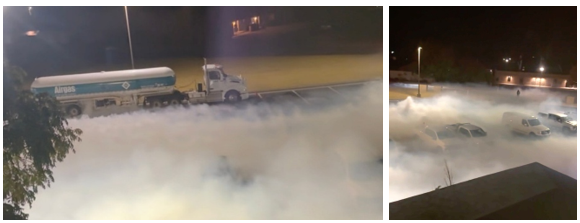
Figure 1. Ammonia leak from a tanker truck in Oklahoma, USA (November 2025). The released ammonia formed a white vapour cloud that stayed close to the ground (left) before gradually rising as it warmed and mixed with the air (right). The incident resulted in 45 hospitalisations, including 5 individuals airlifted for treatment. Of the 14 responding police officers exposed to the vapour, 5 sustained chemical burns to their airways. No fatalities were reported. (Source: ABC News)
As the cloud warms, it becomes lighter and begins to rise, shifting from lateral spreading to upward dispersion. During early phases, lateral travel for several hundred metres is possible, especially under strong winds. Importantly, the visible plume depends on humidity, and the toxic zone may extend beyond the observed cloud (Figure 2).
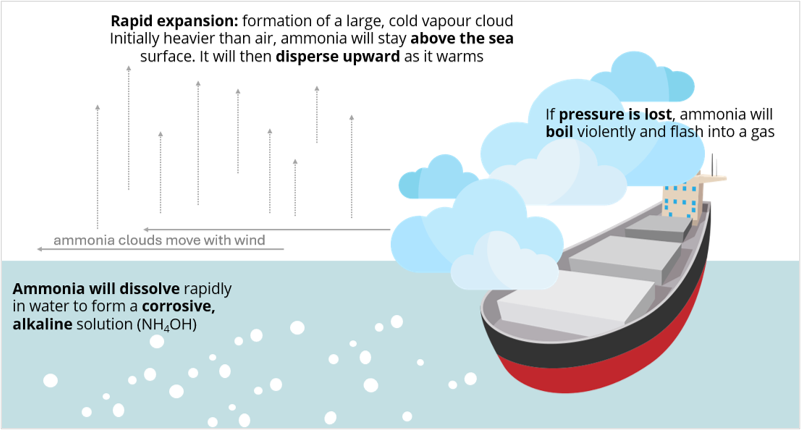
Figure 2: Expected behaviour of a ship-sourced ammonia release from above the waterline
On the other hand, dissolution is rapid and exothermic: ammonia reacts with water to form ammonium hydroxide (NH4OH), creating short-lived spikes in temperature and pH near the release point. This results in a highly corrosive solution (pH >11) nearby the release location, within seconds. Seawater’s buffering capacity limits large-scale pH change, but significant local shifts can occur close to the spill. Dispersion rate depends on mixing intensity; energetic open waters disperse faster, while sheltered ports and inland waterways disperse more slowly.
Once dissolved, ammonia dissociates into unionised ammonia (NH₃) and ionised ammonium (NH₄⁺). The unionised form is the toxic form because it crosses biological membranes readily (e.g. fish gills), causing cellular damage and interfering with metabolic and neurological functions. The ammonium form is less bioavailable. The ratio between NH₃ and NH₄⁺ depends strongly on pH, temperature and salinity: higher pH and higher temperature increase the proportion of unionised NH₃, implying regional and seasonal variability in toxicity. Unionised NH₃ can volatilise; NH₄⁺ remains dissolved or may bind to sediments. In ports and harbours with slower water movement and finer sediments, ammonium may sorb to sediments and later be released when conditions change or sediments are disturbed.
3) Impacts on human health: Toxicity and corrosivity
Ammonia poses significant health risks because it is both highly toxic and strongly corrosive. It is primarily absorbed through the respiratory tract and is hygroscopic, seeking out moisture and rapidly forming a caustic solution. Eyes, lungs and skin are therefore particularly vulnerable, with corrosive burns occurring as ammonia dissolves into moist tissues.
Exposure to high concentrations can lead to severe and potentially fatal effects, including permanent injury or death by asphyxiation. It is noteworthy that ammonia has a very low odour threshold (approximately 5–20 ppm), providing an early indication of its presence, before it reaches hazardous levels. Direct contact with liquefied ammonia can cause severe corrosive damage to skin and eyes.
Fire risk exists but is typically secondary to toxicity. Ammonia has a relatively narrow flammability range (15.5–27% v/v) (Figure 6) and relatively high ignition energy, making ignition difficult in open air without catalysts or combustible material. However, in particular conditions, ignition of spilled liquid ammonia could produce a pool fire. If an onboard fire occurs, ammonia can break down at high temperatures (around 450°C) to form hydrogen, which is highly flammable. Ammonia could also undergo BLEVE under scenarios involving tanks heating above their boiling point and the failure of gas release systems.
4) Exposure control and operational implications
Exposure control relies heavily on continuous monitoring of airborne ammonia concentrations and selecting personal protection equipment (PPE) based on actual measured concentrations. Respiratory and eye protection are essential, but higher levels of protection are time-consuming to don and physically demanding to use, reducing mobility and operational efficiency. Guidance emphasises that vapours are the key concern and responders should not enter areas containing aerosols or dense gas clouds. For smaller incidents with lower toxicity situations, lower levels of PPE could be favoured.
5) Environmental effects and persistence
Ammonia is considered non-persistent and does not bioaccumulate; it typically clears faster than petroleum hydrocarbons (hours to days in many marine scenarios). Rapid dissipation is driven by volatility, solubility (enabling dilution) and lack of persistent sediment binding. Nevertheless, environmental impact can be substantial close to the release. High ammonia levels can cause nutrient overload, reduce oxygen levels and harm marine life. Fish and corals are particularly sensitive; mangrove species may be more tolerant. In fish, elevated ammonia can damage gills, disrupt metabolism and impair neurological function, affecting the wider food chain.
However, the concentration at which these effects begin is uncertain, given that ammonia naturally occurs in both freshwater and marine systems at low levels (typically 0–0.2 mg/L4). Ammonia concentrations in seawater are generally lower than in freshwater, and because seawater typically has a pH near 8, most ammonia is present in the less toxic ammonium form. For these reasons, it has traditionally been assumed that ammonia in the marine environment would not reach levels high enough to cause widespread harm. However, the volumes that could be released during a ship-sourced incident involving ammonia as a marine fuel are far greater than those normally encountered, and this assumption may need to be revisited.
Overall, ammonia incidents combine rapid partitioning between air and water with severe acute toxicity risk. Significant local ecological impacts are expected, even though persistence is low.
Response considerations for releases of ammonia
Response to an ammonia release is shaped by its tendency to partition between the atmosphere and the water column, with a portion volatilising as a toxic vapour cloud while the remainder dissolves into seawater. As a result, the immediate priority is the protection of human life from inhalation exposure. Crew and responders must be evacuated from affected areas, moving laterally and upwind, while exclusion zones are established and maintained downwind. Continuous atmospheric monitoring using ammonia gas detectors, supported where possible by dispersion modelling, is essential to track vapour movement and inform safe decision-making. Remote water sprays may be used to reduce airborne concentrations, although water should not be applied directly to liquid ammonia pools.
In parallel, the potential for fire or explosion must be managed by controlling ignition sources and cooling any tanks exposed to heat or flame. Traditional containment and recovery are not feasible, and satellite imagery offers limited operational value. Vapour management therefore relies on targeted interventions, including water sprays or curtains to suppress or deflect vapour clouds, physical shielding or covering for small releases, and passive ‘monitor and evaluate’ approaches where conditions make active intervention unsafe.
Short-term measures such as tarping may be used for small, localised releases to suppress vapour generation and buy time for source control, provided personnel operate in appropriate protective equipment. Water curtains and fog systems can also reduce airborne concentrations, although their effectiveness is limited by plume size and wind conditions, and they generate corrosive runoff that must be managed. In situations where direct intervention offers little benefit, natural dispersion and dissolution may be allowed to reduce concentrations, supported by continuous monitoring.
Management of ammonia dissolved in water focuses on monitoring ammonia concentrations and pH to understand plume behaviour. Where feasible, dilution and dispersion are promoted through natural or mechanical mixing, with aeration used in enclosed or sensitive areas to reduce ecological impacts. Additional protective measures may include exclusion zones around aquaculture facilities, fisheries and critical water intakes, as well as temporary fisheries closures. Ongoing wildlife monitoring supports assessment of acute impacts and informs any further mitigation measures required.
Special thanks are extended to ITOPF for their invaluable expertise and contribution to the research and development of this article.
[1] Typically at temperatures around 651°C and at concentrations of between 15% and 28% by volume.
[2]NOAA. 1999. “Anhydrous ammonia – CAMEO chemicals profile”. June 1999, NOAA, Washington DC, USA
[3] Raj, P.K., Kalelkar, A.S. 1974. “Prediction of Hazards of Spills of Anhydrous Ammonia on Water”. Report no. CG-D-74, USCG
[4] Chan Tun, et al. A review of ammonia toxicity on aquatic organisms: Species-specific responses, microbial shifts, and environmental interactions. Comparative Biochemistry and Physiology Part C: Toxicology & Pharmacology, 2026 (30): 110388.
Related news
-

米国によるイラン産石油取引の猶予期間について ― 最新動向と主な影響
16/07/2026
-
メタノール ー 代替燃料流出への対応上の留意点
23/07/2026
-
LNG-代替燃料流出への対応上の留意点
15/07/2026
-

米国がイラン石油取引に関する制裁を緩和 ― メンバーへの主な影響
01/07/2026