

Fuel characteristics and industrial background
Methanol is a leading candidate in shipping’s near-term decarbonisation pathway, supported by more than a century of global production, handling and bulk transport experience. It is widely used as a chemical feedstock, industrial solvent and energy source, and has also been deployed as a blended automotive fuel. As a result, there is a comparatively mature understanding of its material compatibility, storage requirements and safety controls for spill and leak prevention relative to less operationally established alternatives.
A key operational advantage is that methanol is a liquid at ambient temperature and pressure, enabling storage in modified tanks on existing vessels and simplifying logistics compared with cryogenic or pressurised fuels.
Production pathways and carbon footprint considerations
Methanol’s lifecycle emissions profile remains a central consideration in its use as a low-carbon marine fuel. A significant proportion of global supply is still fossil-based (grey methanol), and early maritime uptake has largely relied on these volumes. However, lower-carbon pathways are expanding, including bio-methanol and e-methanol, with initial bunkering of bio-methanol occurring from 2023 and early e-methanol volumes emerging from 2025.
The pace of adoption will therefore be influenced not only by vessel readiness, but by the scalability, cost and availability of genuinely low-carbon methanol supply at relevant bunkering locations.
Infrastructure, fleet uptake and retrofit practicality
Methanol integrates more readily with existing shipboard and port infrastructure than ammonia or hydrogen, and retrofitting conventional tonnage is generally considered technically feasible and comparatively cost-effective, requiring fewer modifications to engines and tanks than other alternative fuels.
These practical advantages are reflected in methanol’s growing uptake across the global fleet. Methanol-capable vessels currently account for approximately 8–10% of the global alternative-fuel, newbuild orderbook by tonnage and around 14–17% within the containership orderbook specifically, where adoption is most concentrated. This trend is illustrated by A.P. Moller-Maersk’s deployment of methanol-fuelled container ships such as LAURA MÆRSK and BARCELONA MÆRSK, alongside a wider programme targeting 19 methanol-capable vessels by 2026.
Other major operators, including OOCL and Hapag-Lloyd, have also committed to methanol through newbuild programmes and vessel conversions, while uptake is expanding into bulk carriers and tankers, as demonstrated by vessels such as NYK’s methanol dual-fuel bulk carrier, GREEN FUTURE. Together, these projects indicate that methanol has progressed beyond pilot applications and is being deployed at scale across multiple vessel classes.
Operators are expanding methanol-capable fleets through both newbuilds and conversions, including large container ship programmes, as well as showing growing interest in bulk carrier and tanker segments. However, methanol’s lower energy density compared with conventional fuels means that vessels generally need to refuel roughly twice as often, making the availability of methanol bunkering infrastructure a critical factor for wider adoption. Broader scaling therefore remains sensitive to yard capacity, retrofit timelines and the commercial case for fuel procurement.
Safety, regulatory framework and operational constraints
As a toxic, low‑flashpoint liquid, methanol increases exposure risks during handling and frequent bunkering operations. Fire and explosion risks are addressed through dedicated fuel tank arrangements, inerting with nitrogen, double‑walled piping, leak detection and strict control of ignition sources during transfer. These measures are reflected in the IMO’s Interim Guidelines for the Safety of Ships Using Methyl/Ethyl Alcohol as Fuel. These technical requirements are increasingly reinforced by class rules and operational guidance issued by societies such as ABS, ClassNK and Lloyd’s Register.
From a human element perspective, training requirements remain in development under the IMO’s Generic Interim Guidelines on Training for Seafarers Serving on Ships Using Alternative Fuels and New Technologies, with early implementation largely concentrated among operators already deploying methanol‑fuelled vessels. Fuel quality and custody transfer risks have been reduced through the introduction of ISO 6583:2024 and updated IMPCA reference specifications, providing clearer controls at the bunkering interface.
Notwithstanding this progress, methanol deployment at scale remains constrained by the cost and limited availability of verified low‑carbon methanol, as well as the need to expand dedicated bunkering capacity to accommodate higher refuelling frequency on major trading routes.
Behaviour in the marine environment and associated impacts
1) Containment and transport
Methanol is a clear, volatile, flammable and fully miscible liquid with a slightly alcoholic odour. Because its flashpoint is low (12°C), methanol is classified as a low flashpoint liquid. This classification means that methanol fuel tanks should be constructed of an appropriate grade of stainless steel, or protected internally by methanol-resistant coatings, and should be capable of being inerted with nitrogen.
2) Fate and behaviour following release
Once released into the marine environment, methanol rapidly spreads on the water surface, dissolving quickly while simultaneously undergoing evaporation, without forming a persistent surface slick (Table 1).
Physical property | Value | Behaviour/expected observations |
| Boiling point | 64.5°C | At ambient conditions, methanol is a liquid. |
| Vapour specific gravity (@ 20°C) | 1.1 | Vapours of methanol at ambient conditions are denser than air and will spread above the ground/water surface when spilled. |
| Solubility in water | Fully miscible | Methanol has no limit to its solubility in water; therefore, it won’t form slicks on the water surface. |
| Flammability range | 6.0 – 36.5 (v/v) % | Outside of this range, the methanol/air vapour mixture is not flammable. |
| Flashpoint | 12°C | At room temperature, methanol gives off sufficient vapour to ignite in air. |
Table 1: Summary of key methanol properties dictating its hazards, fate and behaviour
This behaviour fundamentally differs from conventional oil, and it has operational implications (Figure 1).
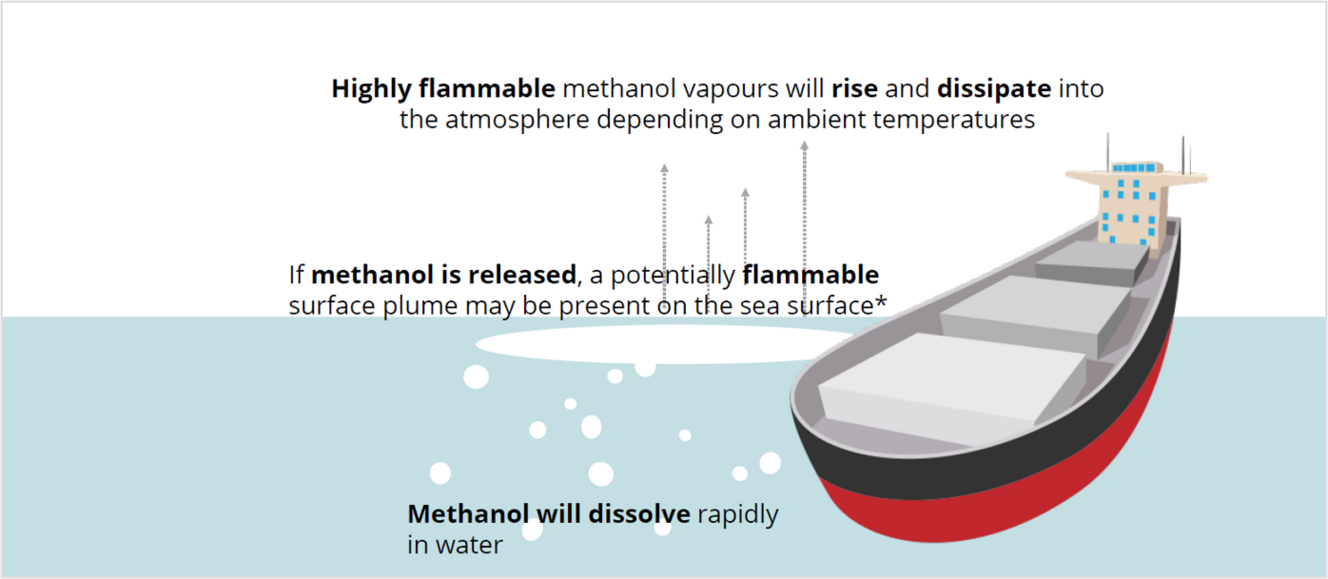
Figure 1: Expected fate and behaviour of methanol after release into the marine environment. The risk of fire remains even at high dilution rates; a solution of 90% water can still be within methanol’s flammable range
Methanol vapours at ambient conditions are denser than air, so vapours emanating from the sea surface will not immediately rise. Instead, they can spread over the ground or water surface, creating a vapour cloud footprint that may be broader than that of LNG. The extent of vapour spreading depends on spill rate and meteorological and oceanographic conditions.
Even in moderate winds, ignition of the vapour cloud can occur and fire may propagate back to the leak source until methanol is consumed below the lower flammability limit (LFL) or is extinguished.
In the marine environment, dissipation depends strongly on mixing, influenced by tidal currents and wind-induced wave action. Methanol releases in open water are expected to disperse to non-toxic levels (<1%) much faster than petroleum hydrocarbons. Some studies have indicated a half-life of between one and seven days, with biodegradation identified as a key mechanism. Volatilisation is also stated to play a major role in decomposition.
3) Impacts on human health: Flammability, explosivity and toxicity
Methanol’s safety hazard profile combines flammability/explosivity with toxicity. Methanol is highly flammable due to its high volatility, low flash point and ability to form combustible vapour-air mixtures. It has a wide flammability range (6.0–36.5% v/v) (Figure 6). While the LFL is relatively high – making ignition unlikely at low concentrations – once this threshold is exceeded, methanol can ignite across a broad span of concentrations.
A critical operational feature is that methanol flames can be almost invisible in daylight and become increasingly invisible when diluted with water (Figure 2).
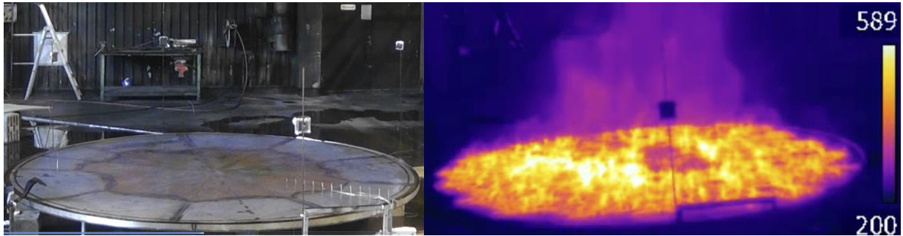
Figure 2. Methanol pool‑fire extinguishing tests from the proFLASH project on methanol fire detection and extinguishment. The image shows a methanol flame that is nearly invisible in daylight, requiring thermal imaging for detection
In unconfined spaces, methanol released from a tank or pipeline will spread as a thin liquid layer and evaporate (and dissolve if water is present). Typically, only the area immediately around the leak reaches concentrations above the LFL. In confined spaces, however, vapours cannot disperse and even small leaks can create flammable vapour-air mixtures. Inside a fuel storage tank, methanol vapour is almost pure and therefore outside the flammable range, but after a leak or rupture, a dense vapour cloud forms and can enter the flammable range as it mixes with air. If an ignition source is present, a flash fire is likely until available fuel is consumed.
Ignition may, in certain circumstances, lead to deflagration-to-detonation transition (DDT) and subsequent large explosion; these events are described as unpredictable and are not well understood at present. Methanol can also pose a boiling liquid expanding vapour explosion (BLEVE) risk if a tank containing liquid methanol is heated above its boiling point (64.5°C) and pressure relief/gas release systems fail.
Toxicity is also an important consideration. Ingestion is unlikely to be the primary concern in a marine pollution incident, but inhalation and skin contact are credible routes. Mild exposure to vapours can cause symptoms similar to alcohol intoxication (headaches, dizziness, nausea, blurred vision). More serious outcomes may be delayed by 10–48 hours because methanol is metabolised into formaldehyde and formic acid. Severe symptoms may include abdominal pain, temporary or permanent vision loss, coma, or death in extreme cases. Harmful effects from inhalation or skin contact generally require prolonged exposure to high concentrations[1].
4) Exposure control and operational implications
Where methanol vapour concentrations may approach the LFL, responders should use structural firefighting gear, consistent with the fire-dominated risk. Where flammability is unlikely, toxicity becomes the primary concern. In such cases, respiratory and chemical-resistant, compatible clothing may be required. The appropriate protection level depends on airborne concentration and expected skin contact, reinforcing the need for atmospheric monitoring and careful risk assessment before initiating response operations.
5) Environmental impact: Ecotoxicity
Methanol is biodegradable, water soluble and less toxic than ammonia, but it can still be harmful to fish, crustaceans and microorganisms. It does not bioaccumulate, and impacts are expected to be short-lived.
In air, methanol has a half‑life of approximately 3–30 days, with removal also through rainfall. In water, the half‑life is shorter, generally 1–7 days.
The concentration considered environmentally safe for marine waters, based on short‑term toxicity thresholds intended to protect most species, is predicted to be exceeded in large spill scenarios, according to modelling. However, in open ocean settings, wave action, wind, tides and dilution typically reduce concentrations to non‑toxic levels within hours to days.
Overall, methanol combines rapid dissolution and evaporation with significant fire and explosion potential, alongside manageable but important toxicity considerations. Its environmental impacts are generally short-lived, driven primarily by dilution and biodegradation.
Response considerations for releases of methanol
Incident management for methanol should first prioritise the primary hazards – namely ignition risks and atmospheric toxicity – before any additional response actions are considered. If intervention is required, it is important to recognise that methanol behaves as a dissolver evaporator: a portion will volatilise into the atmosphere, while the remainder will dissolve completely in water. Consequently, methanol will not form a surface slick, making visual detection extremely challenging.
In general, response strategies for evaporators and gases rely on several core actions: continuous monitoring – using real-time detection and trajectory modelling where available – to track the extent of contamination; establishing exclusion zones; and reducing the risk of fire or explosion by managing ignition sources. Water curtains may be used to deflect or limit the spread of vapour plumes. Because vapour releases cannot be mechanically recovered, natural attenuation becomes the primary mechanism for reducing concentrations.
As with other dissolvers, response in the water column focuses on enhancing dilution and advection. Remote sensing methods, such as satellite imagery, offer no operational value because dissolved substances cannot be observed. Instead, the likely extent of contamination is inferred through trajectory modelling, which helps assess potential impacts on marine ecosystems and nearby fisheries.
Response strategies for methanol in air
Containment is not feasible, so the main response approaches for methanol vapours are aimed at dispersing vapour plumes and monitoring their trajectory.
Water curtains, sprays or fog systems can help disperse or divert vapour plumes and remove methanol from the air due to its high solubility and tendency to transfer readily into the water phase. These are best used at short range, as large or rapidly moving plumes may extend beyond the reach of the spray, and strong winds can significantly reduce efficiency by dispersing water droplets before they interact with the gas.
Response strategies for methanol in water and sediments
Methanol has low environmental persistence, and measures that promote mixing and dilution – such as propeller wash – can reduce the time needed for concentrations to return to safe levels. Monitoring is therefore the primary pollution-management tool, focusing on tracking concentrations and environmental conditions, as mechanical recovery is not feasible. In-situ burning is not recommended, as it would be considerably more hazardous and unpredictable than for oil spills.
For sediments, there is no substantial operational experience with large methanol releases causing significant benthic contamination. While techniques such as tilling to accelerate evaporation or surf washing may be theoretically considered, they remain untested for methanol. Given methanol’s high evaporation rate and rapid natural degradation, a passive approach is generally sufficient; however, where faster recovery is needed, limited sediment-disturbance techniques may help accelerate natural attenuation.
[1]Machiele, P.A. 1989. “A perspective on the flammability, toxicity, and environmental safety distinctions between methanol and conventional fuels”. US Environmental Protection Agency.
Related news
-

米国によるイラン産石油取引の猶予期間について ― 最新動向と主な影響
16/07/2026
-
LNG-代替燃料流出への対応上の留意点
15/07/2026
-

米国がイラン石油取引に関する制裁を緩和 ― メンバーへの主な影響
01/07/2026
-
深刻化する課題、海上での貨物火災への取り組み
17/06/2026