Malaysia has introduced new navigational and operational requirements within a Marine Sensitive Area (MSA) near the eastern approaches to the Singapore Strait. The requirements are set out in Marine Sensitive Area Notice (MSA 01/2026), which took effect on 11 September 2026.
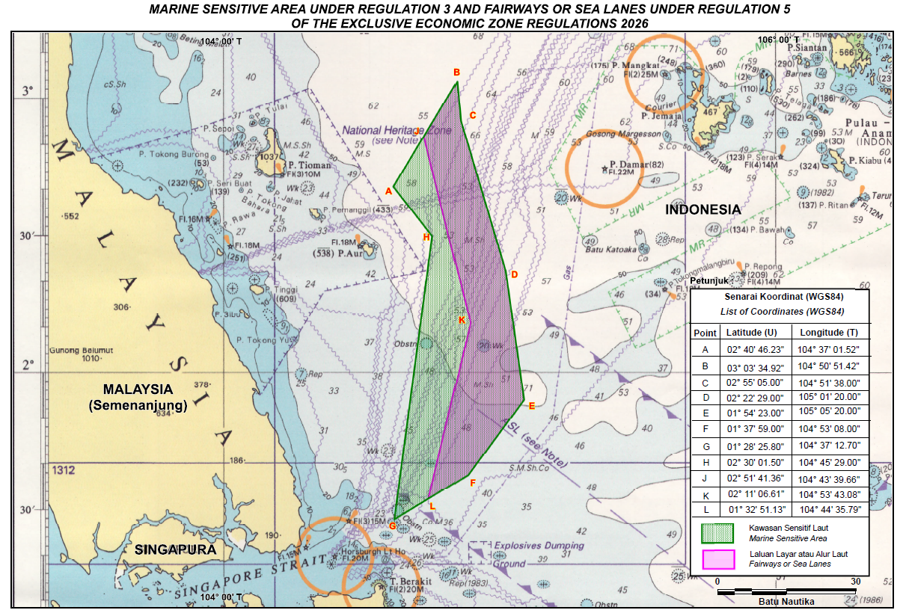
The MSA has been established under Malaysia’s Exclusive Economic Zone Regulations 2026 to protect, preserve and conserve protected features and to prevent, reduce and control pollution from marine structures. The Appendix sets out the boundaries of the MSA, together with designated fairways or sea lanes, using WGS84 coordinates.
Key requirements for vessels
Members should note the following requirements within the MSA:
- Anchoring: Vessels must not anchor within the MSA except for search and rescue operations, where anchoring is due to damage to the vessel, or for combating specific pollution incidents.
- Vessel size: A cargo vessel or oil tanker exceeding 300 metres in length and 40 metres in width must not enter the MSA.
- Speed: All vessels navigating within the MSA are subject to a maximum speed of 12 knots.
- Cargo transfer: Cargo transfer is not permitted unless written permission has been obtained from the Malaysian Government.
- Bunkering: Bunkering operations are prohibited.
- Other activities: Dredging, salvage operations, installation of structures, cable or pipeline works, research activities, seismic activities and mining or extraction of seabed resources are prohibited unless written approval has been obtained from the Malaysian Government.
The Notice also requires the owner, Master or agent to ensure that the vessel, or any activity carried out from it, does not kill, take, destroy or disturb flora or fauna within the MSA. Activities involving the exploitation of fishery resources are subject to approval from Malaysia’s Department of Fisheries. Failure to comply with the protective measures constitutes an offence under the Exclusive Economic Zone Regulations 2026.
What this means in practice
The practical implications of the MSA extend beyond its individual restrictions. Its location near the eastern approaches to the Singapore Strait means that it should be considered at an early stage of passage and operational planning.
The designated area also affects waters commonly referred to within the industry as the eastern Outer Port Limits (OPL). Members should not assume that a location described commercially as OPL is available for unrestricted anchoring or other operations. Before arranging anchoring, bunkering or cargo transfer operations in the vicinity, operators should establish the vessel’s intended position in relation to the MSA and verify the applicable Malaysian requirements and any permissions that may be required.
The location of the MSA may also influence traffic movements near the eastern approaches to the Singapore Strait. Masters and bridge teams should take this into account when preparing and monitoring the passage plan, with particular attention to traffic entering or leaving the Singapore Strait.
Guidance for Members
For vessels trading through, waiting or conducting operations in the vicinity, Members should consider the following before arrival:
- Check the intended route against the MSA boundaries. The official coordinates and designated fairways or sea lanes are contained in the Appendix to MSA 01/2026 and should be checked as part of the passage-planning process.
- Establish whether the dimensional restriction applies. Cargo vessels and oil tankers exceeding both 300 metres in length and 40 metres in width must not enter the MSA.
- Proceed at a safe speed. Vessels navigating within the MSA must not exceed 12 knots. Masters should take the speed restriction into account when planning the passage, while continuing to proceed at a safe speed appropriate to the prevailing circumstances and conditions.
- Plan any anchoring arrangements in advance. Vessels must not anchor within the MSA except in the limited circumstances permitted by the Notice. Where anchoring is required, Members should identify an appropriate designated anchorage and confirm with the local agent or relevant authority that the proposed position is permitted and that any necessary approvals or permissions are in place before anchoring.
- Review traffic conditions. Masters and bridge teams should remain alert to traffic entering or leaving the Singapore Strait and to vessels whose movements may be influenced by the MSA.
- Check operational arrangements in advance. Proposed cargo transfer or bunkering operations should be reviewed against the applicable restrictions before the vessel arrives in the area. Within the MSA, cargo transfer requires written permission from the Malaysian Government, while bunkering is prohibited.
- Do not rely solely on commercial descriptions of a location. Where an anchoring or operational position has been provided by a charterer, agent or service provider, its geographical position should still be checked against the official MSA coordinates and applicable local requirements.
- Seek local clarification where necessary. Where there is uncertainty over an intended route, anchoring position or operation, Members should obtain current advice from their local agent or the relevant Malaysian authorities before proceeding.
The UK P&I Club has previously highlighted the risks associated with unauthorised anchoring in Malaysian and Indonesian waters. The new MSA introduces a separate set of specifically defined navigational and operational requirements which Members should now take into account when planning voyages and operations close to the eastern approaches to the Singapore Strait.
The MSA boundaries, vessel dimensions, intended route, speed requirements and any proposed anchoring, cargo transfer or bunkering operations should be checked as part of the vessel’s pre-arrival and passage planning.
Members, operators and Masters are recommended to review MSA 01/2026 and its Appendix before operating in or near the MSA and, where necessary, seek current advice from their local agent or the relevant Malaysian authorities.
Source: Government of Malaysia, Marine Sensitive Area Notice MSA 01/2026. (also attached below)
Related news
-

-
-
S-100 and the Next Evolution of ECDIS
06/10/2026
-